This video provides information about how to prepare for SYFOVRE administration.
SYFOVRE is a complement inhibitor indicated for the treatment of geographic atrophy (GA) secondary to
age-related macular degeneration (AMD).
SYFOVRE is contraindicated in patients with
ocular or periocular infections, in patients with active
intraocular inflammation, and in patients with
hypersensitivity to pegcetacoplan or any of the
excipients of SYFOVRE. Systemic hypersensitivity
reactions (for example, anaphylaxis, rash, urticaria)
have occurred. We will cover additional Important
Safety Information for SYFOVRE later in this video.
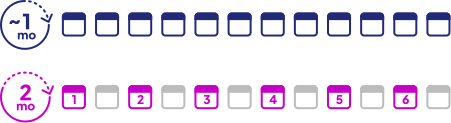
The recommended dose for SYFOVRE is 15 mg (0.1 mL of 150 mg/mL solution) administered by intravitreal
injection to each affected eye once every 25 to 60 days. Store SYFOVRE in the refrigerator between 2
degrees Celsius to 8 degrees Celsius, 36 degrees Fahrenheit to 46 degrees Fahrenheit. Remove the carton
from the refrigerator, keeping the vial in the original carton to protect from light.
Prior to injection, allow the carton to come to room temperature, 20 degrees Celsius to 25 degrees
Celsius, 68 degrees Fahrenheit to 77 degrees Fahrenheit for at least 15 minutes, but no longer than 8
hours, which may help prevent increased injection forces. Fill the syringe immediately prior to the
injection.
It’s important to not shake the vial. The vial is for use in a single eye.
Inspect the solution. It should be a clear, colorless to light yellow aqueous solution. Do not use if:
- particulates, cloudiness, or discoloration are visible
- the vial shows signs of damage or tampering,
- the expiration date has passed
- the packaging or components show signs of damage or tampering
STEP 1
Gather the supplies needed:
- One SYFOVRE vial, (included in the product box)
Additional supplies needed:
- Vial kit with injection components are provided by Apellis. The injection kit includes:
- One sterile 5-micron filter needle
- One sterile ½ inch 29-gauge extra thin-wall injection kit needle with Luer-lock hub or a 27-gauge needle with Luer-lock hub
- Note: Increased injection forces or increased injection time could be experienced if a smaller diameter injection needle is used (for example, a 30-gauge)
- You will also need one sterile 1-mL Luer-lock syringe with a 0.1-mL dose mark
- Lastly, you’ll need an alcohol swab
Use aseptic technique to carry out the following preparation steps:
STEP 2
Remove the flip-off cap from the vial and clean the vial septum with an alcohol swab. Wait for the
alcohol to dry out.
STEP 3
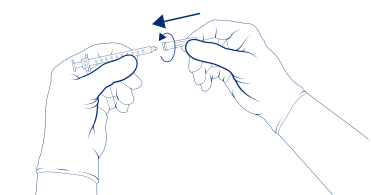
Attach the 5-micron filter needle onto a 1-mL Luer-lock syringe by twisting it onto the Luer-lock
syringe tip.
STEP 4
Push the filter needle into the center of the vial septum until the needle is submerged in the drug
product to prevent withdrawal of air. To withdraw the entire contents of the vial into the syringe, hold
the vial at a slightly inclined position. Withdraw the drug product slowly to prevent air bubbles.
Continue to tilt the vial during withdrawal keeping the bevel of the filter needle submerged in the
liquid until all of the fluid is withdrawn from the vial. Do not tap the syringe to remove air bubbles.
While maintaining the filter needle within the vial, invert the syringe and move the plunger down and up
until bubbles move to the top.
STEP 5
Using aseptic technique, disconnect the filter needle from the syringe and dispose of it. Do not use
the filter needle for injection.
STEP 6
Aseptically and firmly attach the injection needle onto the 1-mL Luer-lock syringe.
STEP 7
Check for air bubbles by holding the syringe with the needle pointing up. Do not tap the syringe to
remove air bubbles. To remove any air bubbles and/or prepare the syringe for injection, remove the
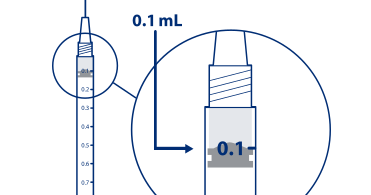
needle cap and with the needle end facing up gently advance the plunger to the 0.1-mL dose mark. Only
0.1mL (15 mg of SYFOVRE) should be administered to deliver a single dose. Any excess volume should be
disposed. The syringe is now ready for injection. Ensure that the injection is given
immediately after the preparation of the dose. Any unused medicinal product or waste
material should be disposed of in accordance with local regulations. For additional information,
including injection procedure, see Dosage and Administration, Section 2, of the SYFOVRE full Prescribing
Information.
INDICATION
SYFOVRE® (pegcetacoplan injection) is indicated for the treatment of geographic atrophy (GA) secondary
to age-related macular degeneration (AMD).
IMPORTANT SAFETY INFORMATION
CONTRAINDICATIONS
- SYFOVRE is contraindicated in patients with ocular or periocular infections, in patients with active intraocular inflammation, and in patients with hypersensitivity to pegcetacoplan or any of the excipients in SYFOVRE. Systemic hypersensitivity reactions (e.g., anaphylaxis, rash, urticaria) have occurred.
WARNINGS AND PRECAUTIONS
-
Endophthalmitis and Retinal Detachments
- Intravitreal injections, including those with SYFOVRE, may be associated with endophthalmitis and
retinal detachments. Proper aseptic injection technique must always be used when administering
SYFOVRE to minimize the risk of endophthalmitis. Patients should be instructed to report any
symptoms suggestive of endophthalmitis or retinal detachment without delay and should be managed
appropriately.
-
Retinal Vasculitis and/or Retinal Vascular Occlusion
- Retinal vasculitis and/or retinal vascular occlusion, typically in the presence of intraocular inflammation, have been reported with the use of SYFOVRE. Cases may occur with the first dose of SYFOVRE and may result in severe vision loss. Discontinue treatment with SYFOVRE in patients who develop these events. Patients should be instructed to report any change in vision without delay.
-
Neovascular AMD
- In clinical trials, use of SYFOVRE was associated with increased rates of neovascular (wet) AMD or
choroidal neovascularization (12% when administered monthly, 7% when administered every other month
and 3% in the control group) by Month 24. Patients receiving SYFOVRE should be monitored for signs
of neovascular AMD. In case anti-Vascular Endothelial Growth Factor (anti-VEGF) is required, it
should be given separately from SYFOVRE administration.
-
Intraocular Inflammation
- In clinical trials, use of SYFOVRE was associated with episodes of intraocular inflammation
including: vitritis, vitreal cells, iridocyclitis, uveitis, anterior chamber cells, iritis, and
anterior chamber flare. After inflammation resolves, patients may resume treatment with SYFOVRE.
-
Increased Intraocular Pressure
- Acute increase in IOP may occur within minutes of any intravitreal injection, including with
SYFOVRE. Perfusion of the optic nerve head should be monitored following the injection and managed
as needed.
ADVERSE REACTIONS
-
Most common adverse reactions (incidence ≥5%) are ocular discomfort, neovascular age–related
macular degeneration, vitreous floaters, conjunctival hemorrhage.
Please see full Prescribing Information on SyfovreECP.com.
For more information about SYFOVRE, visit SyfovreECP.com.